Goal: Client wanted to write a well-researched article that ranks for ‘global data privacy compliance in 2023’ – an important long-tail keyword. In late 2022, SERPs mostly featured pieces that were either poorly written ‘SEO-only zero value to readers’ pieces or lawyer-written legal speak.
Approach: I started by researching all popular global data privacy laws and identified ‘data residency’, ‘compliance fines’ and ‘data sharing’ as huge barriers that prevented businesses from achieving compliance. I used this as the problem statement and how Skyflow’s solution solved this problem as my thesis. I focused on adding value to readers through plenty of relatable examples, images summarizing key concepts, and code snippets. I also differentiated this article by focusing on the problems faced by business owners and product managers (not their legal team) while struggling with compliance for their digital offerings across countries.
Result: Client was featured in the top 3 SERPs within the first few weeks. Client reused content, examples and images to create emails and social media posts to convert enquiries from people interested in solving global compliance. 20+ months later, data privacy and residency remains one of Skyflow’s strongest entry-point use cases.
Since 2018, more than a dozen countries have enacted new data privacy laws. And many more countries are on the verge of adopting new data laws.
If you thought achieving GDPR compliance was tough, imagine complying with several GDPR-like regulations, each with its own localized data privacy interpretations.
Instead of customizing your backend data infrastructure to comply with each upcoming or existing privacy law, consider storing sensitive business information in a data privacy vault to simplify global data privacy compliance.
Why Is Global Data Privacy Compliance Important
Businesses need to store and manage sensitive data across many regions, in accordance with local data privacy laws. Otherwise, they risk legal penalties including fines or other sanctions.
For example, let’s say your U.S.-based business has a subsidiary company that collects personally identifiable information (PII) and credit card data from users in Australia. You cannot store this sensitive data in your U.S. company database or analyze queries like “highest Australian customer sale last week” with managers of your U.S.-based business. Why? Because doing so violates APP 8, which instructs businesses to avoid cross-border disclosure of personal information with another entity.
Such violations of global data privacy laws can have negative consequences for your business, including:
Hefty fines: The Australian government recently increased the data privacy penalty limits from 2.2 million to 50 million in record time. Such fines apply to businesses of all sizes. For instance, a large multinational business like Meta faced a GDPR fine of 1.2 billion euros, while a local German chat website was also fined 20,000 euros.
Bad press: Besides costly penalties, non-compliance with local data privacy laws can harm or ruin your business reputation. For example, in addition to facing a £18.4 million fine ($23m) after a 2020 data breach, Marriott International paid an even larger price when its share price dropped by 8.7% in the aftermath of this incident.
Local bans: Violating data privacy laws like GDPR can bar your business from operating in that region. For example, the Italian Supervisory Authority (SA) briefly banned ChatGPT from operating in Italy on March 31, 2023, because OpenAI, a U.S.-based company, hadn’t yet implemented an age-verification system to prevent the service from collecting data from children. This ban was subsequently lifted, but one can’t count on local bans being short-lived.
Simplify Global Data Privacy Compliance With Skyflow
A data privacy vault eases compliance with all existing and upcoming data privacy laws by:
1. Isolating sensitive data and avoiding sprawl
2. Enabling fine-grained access controls
3. Implementing secure data sharing
1. Isolating Sensitive Data and Avoiding Sprawl
Isolating sensitive data in a Skyflow vault away from other data records is akin to storing your credit card safely in a purse, away from a box of bills. Such a separation reduces your compliance footprint and enables you to protect sensitive data with advanced obfuscation techniques.
A vault also prevents sensitive data sprawl, a phenomena that occurs when sensitive data is copied and stored across various applications, databases, data pipelines, and logs. Sprawl makes it impossible to effectively govern access and increases global data privacy compliance efforts.
For instance, sprawl may occur when you store customer information in your CRM, which later gets replicated to the billing system, data warehouse, analytics, and a few third-party SaaS apps. Because all these tools now contain sensitive data, you must include them in your compliance audits or certifications, thus increasing compliance complexity.
When you start investigating the extent of sensitive data sprawl in your systems, you’ll likely discover that sensitive data is present nearly everywhere, across several front-end applications, APIs, databases, ETL/ ELT pipelines, and AI/ ML models.
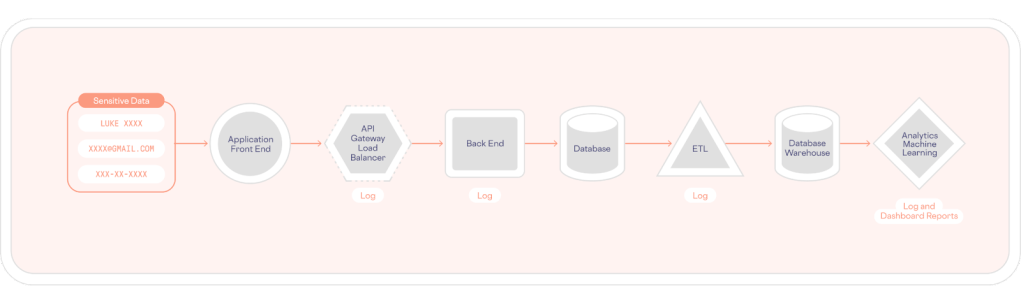
Sensitive Data Sprawl Across All Your Apps, Tools, APIs, and AI/ ML Models
Avoid sensitive data sprawl by storing sensitive data in a centralized Skyflow Data Privacy Vault and sharing them via tokens with all your external apps.
For example, if your billing system wants a customer’s credit card details, instead of sending the card number as plaintext, you’ll send an equivalent Skyflow token (we’ll discuss how Skyflow tokens work later in this article).
So, with Skyflow, the above example architecture will now look like this:
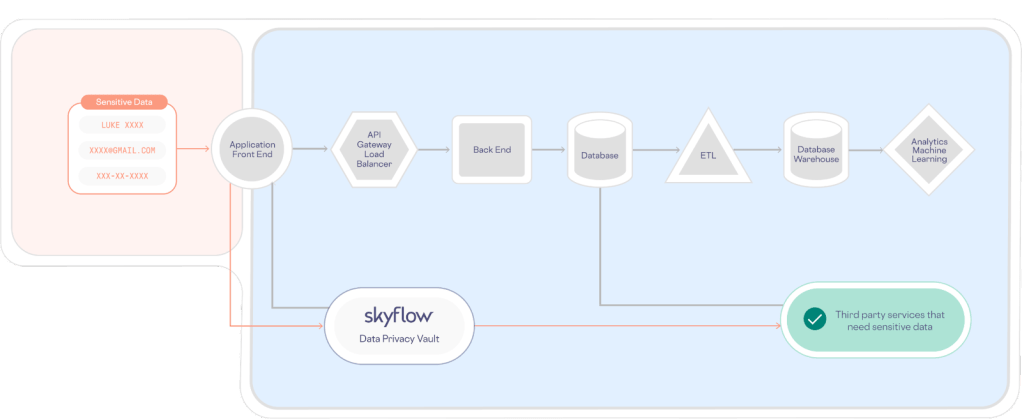
Avoid Sensitive Data Sprawl By Sending Skyflow Tokens Instead of Text Data
2. Enabling Fine-Grained Access Controls
Businesses need fine-grained access control to comply with various data privacy and residency requirements.
For instance, Principle 8 of the Australian Privacy Act, Article 9 of the GDPR, and other data privacy laws across the world restrict sensitive data from leaving the region where it originates from.
Ease compliance with data residency requirements by storing sensitive business data from a particular region inside a localized Skyflow vault that is hosted within that very same region.
For example, you can have one vault located in Brazil to manage the data of all your Brazilian users, and another vault in the EU to manage the personal data of all your EU users.
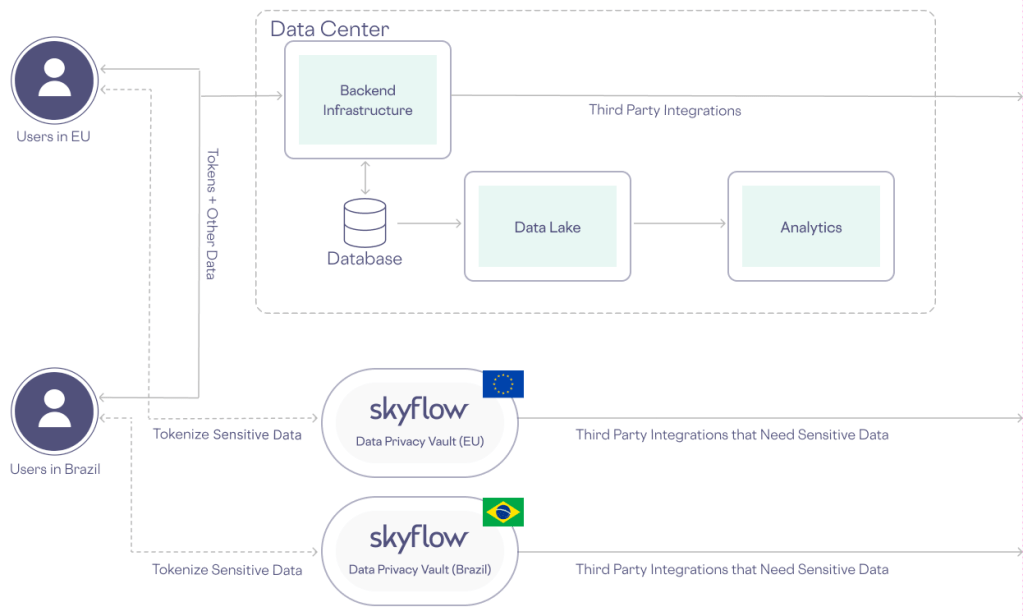
Using Regional Skyflow Vaults Eases Data Residency Compliance
In addition to managing residency requirements, you’ll also need a way to control who can access what data or format.
For example, to comply with the data residency requirements of APP 8, only your Australian agents must be able to access the personal information of Australian users from your Skyflow vault located in Australia. You can enforce such a policy in Skyflow with the following governance policy.
ALLOW READ ON users.info WHERE agent.country = "Australia" Skyflow helps you establish new data governance policies, implement fine-grained access controls and assign roles and attributes for each resource without needing to build any custom software features.
3. Secure Sharing of Sensitive Business Data
Businesses needs to share data in with external entities such as payment processors, vendors, and third-party tools. However, data privacy laws such as GDPR, PIPEDA, PDP, POPIA, and LGPD, strictly limit or prohibit the transfer of sensitive data outside the region where the data originates from.
You can solve this conundrum by using Skyflow to swap sensitive data with non-exploitable tokens. Because these tokens don’t contain sensitive data, you can freely share them with external entities, without risking data breaches or non-compliance. And when required, authorized parties can de-tokenize these tokens to retrieve plaintext sensitive data from your vault.

Use Skyflow Tokens To Replace Sensitive Data with Non-exploitable Tokens
Restricted sharing of sensitive personal information hinders global data privacy compliance.
For instance, Article 25 of the GDPR, Principle 3 of the Australian Privacy Act, Section 24 of the Singapore Personal Data Protection Act, Section 2 of the South Korean Personal Information Protection Act, and the HIPAA de-identification standard all instruct businesses to limit the use of personal data to a few specific and authorized purposes. These laws also require businesses to implement security measures that prevent data breaches.
Skyflow allows you to restrict data sharing by de-identifying sensitive data records. For example, if your customer service agents (CSA) only require the last four digits of social security numbers (SSN) for customer verification purposes, you can use the below Skyflow rule to mask the first five SSN digits and reveal only the last four digits.
SELECT REDACTION(card_number,'MASK') FROM 'ssn'As a result, plaintext SSN such as 407-12-237 will become XXX-XX-237.
Skyflow also offers secure connections to third-party APIs. So, you can connect to a card payment network like Visa or issue physical checks via PostGrid. These connections allow you to securely integrate trusted third party services and tools into your offerings to support scenarios like card issuance and payment orchestration. This is one of the main reasons that fintech startups like Apaya use Skyflow to ease global data privacy compliance.
Startups Like Apaya Use Skyflow to Protect Data and Ease Global Compliance
Apaya, a no-code payments automation platform, is quickly scaling its operations across Europe, the Middle East, and Africa. To comply with PCI DSS and the various data privacy laws in these regions, Apaya needed to protect sensitive data, implement data governance, and meet data residency requirements.
Instead of building these capabilities in-house, Apaya partnered with Skyflow to build a modular and scalable solution. Today, Apaya uses Skyflow vaults located in the Middle East and Europe to capture, tokenize, and store sensitive PCI data. Each vault stores all sensitive data records within the region and sends tokenized data to trusted third-party payment processors.
As a result, Apaya can provide its customers with seamless custom payment flows and ease their compliance burden.

Apaya Uses Skyflow To Ease PCI and Data Residency Compliance in the Middle East and the Europe Union
Try Skyflow
Businesses that handle sensitive data needs a comprehensive data privacy compliance strategy along with the right tools to execute that strategy.
Contact us to learn how the Skyflow Data Privacy Vault can ease global data privacy compliance for your business.
Note: This article was ghost-written for Skyflow’s blog.
 Aditya Tejas